FUE vs DHI: Which One Is Right for You?
Ever wondered, “What if the choice you make changes everything?” Revive your roots because you deserve to feel your best. Since, choosing between FUE and DHI can impact not only your hair restoration journey but also your self-confidence. Once the differences are clear, the decision feels less overwhelming.
It’s a new world order where wise individuals regain confidence through modern treatments such as FUE and DHI hair transplant surgeries, which deliver natural and lasting results. The ideal option depends on expectations, hair condition, and the level of refinement required for the final look, as even a minor preference here can significantly transform the entire appearance.
Difference Between FUE and DHI Hair Transplant – A Complete Guide
Among the most discussed options, the comparison of FUE vs DHI hair transplant, which is better, continues to gain attention. Let’s break it down in a smarter way to look at the key points when you want to save your time. Good decisions come from good information.
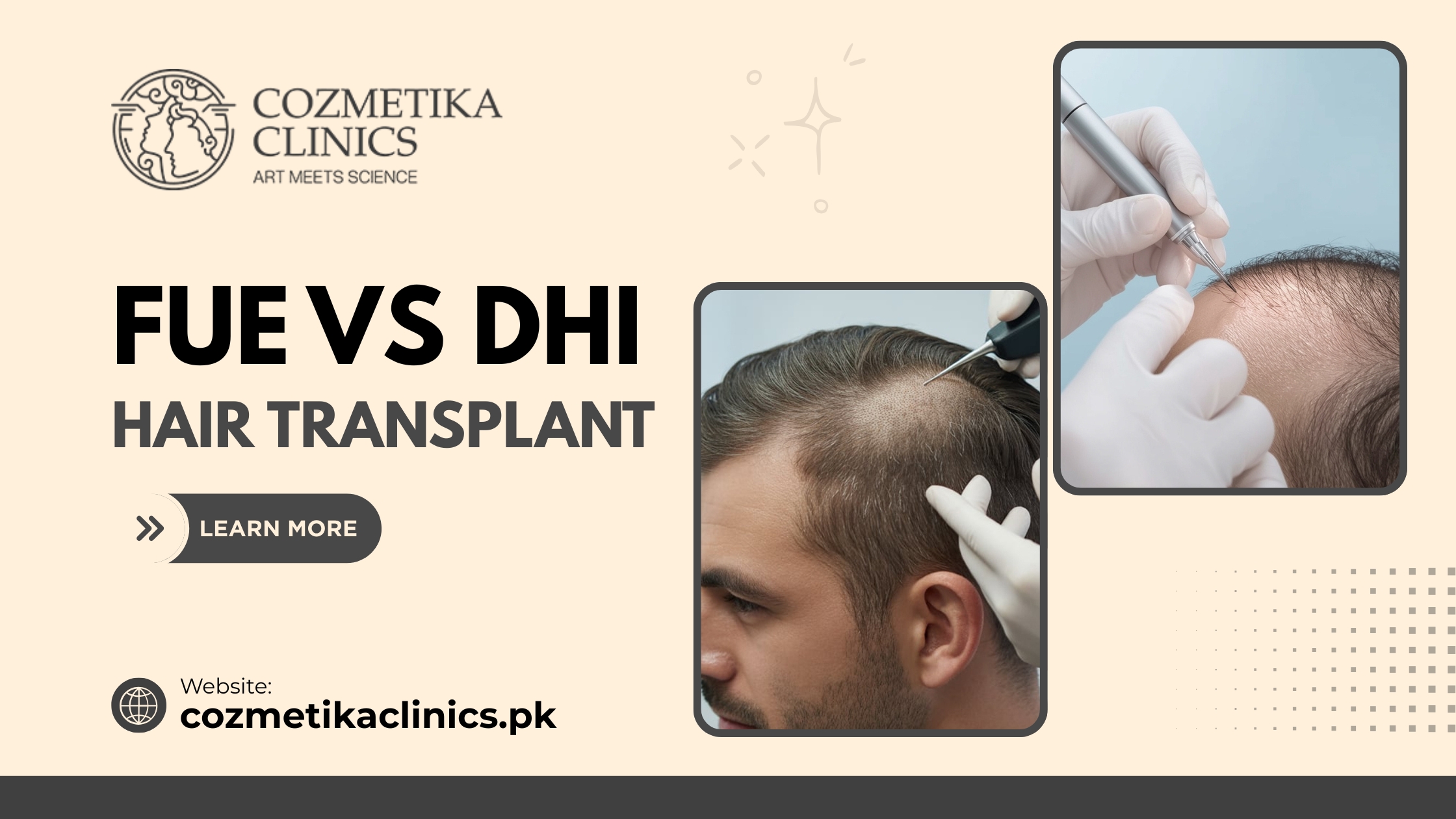
FUI Technique: Individual hair follicles are extracted and then implanted into thinning areas (areas with hair loss).
DHI Technique: Extracted hair follicles are implanted directly into the scalp using a specialized pen tool.
What Is a Hair Transplant Method?
Using your own hair for durable results and natural hair loss treatment, a permanent hair transplant procedure moves healthy hair follicles from one area of the scalp to another. Many people go for it because it continues to grow organically over time.
FUE vs DHI: Cost Comparison
Money fades, yet the results stay with you for years. An exceptionally low-priced hair transplant could appear attractive, but they often signal compromises on clinical condition, surgeon’s proficiency, or hygiene standards. These initial savings can lead to many additional procedures and higher corrective hair transplant costs in the long run. Cost matters less when the result changes your confidence.
FUE: Budget-friendly
DHI: Higher charges
FUE vs DHI: Hair Transplant Results
Be aware that the hair transplantation does not stop ongoing hair loss. Both techniques provide reliable and strong results when performed correctly. To help set realistic expectations, we’ve gathered some basic points.
FUE Results
- Natural growth pattern
- Suitable for advanced hair loss
DHI Results
- Better control over hairline design
- More precise placement
FUE vs DHI: Recovery Time
Overall, FUE vs DHI recovery time remains quite similar, with minor differences in early healing stages.
FUE Recovery
- Mild redness for a few days
- Scabs heal within 10-14 days
- Suitable for advanced hair loss
DHI Recovery
- Faster visible healing in many cases
- Less surface impact on the scalp
Hair Transplant Recovery Timeline
Turn your hair loss into a story of confidence, self-assurance, and fresh beginnings. Moreover, a proper recovery routine supports improved results.
| Days 1-5: Initial healing phase |
|---|
| Weeks 2-4: Shedding phase begins |
| Months 3-6: New hair growth shows up |
| Months 9-12: Final hair transplant results become visible |
Difference Between FUE and DHI Hair Transplant
Consequently, FUE and DHI are two excellent techniques, each with its own specific benefits.
Below is a demonstration of how DHI and FUE are different in table form:
| FUE | DHI |
| Follicular Unit Extraction | Direct Hair Implantation |
| Two-step process | One-step process |
| Micro punches/forceps | Specialized implantation pen |
| Channels created before implant | Direct implantation, no cuts |
| Good for wider coverage | Best for hairline and density in targeted areas |
| Small dot scars | Less visible |
| More affordable | Higher cost due to the advanced technique |
| Usually, a shorter procedure | Can take more time |
| Slightly longer healing (donor area) | Faster early recovery in many cases |
FUE vs DHI Hair Transplant: Which is better
Do you want to know what professionals actually recommend? Look! The suitable method depends on your personal desires, right?
Choose FUE if:
- You need even coverage for larger areas
- You prefer a cost-effective option
Choose DHI if:
- You want a defined hairline
- You aim for higher density in smaller areas
Therefore, take your time, compare options carefully, and select a method that matches your purpose. Moreover, surgeons may even suggest a dual strategy in specific cases to maximize the positive outcome.
Limitations and Contraindications
The following are some common mistakes you should avoid when selecting between FUE and DHI:
- Ignoring proper research
- Focusing only on low cost instead of quality and results
- Selecting a clinic without verifying its expertise or patient reviews
- Not asking enough questions during consultation
- Neglecting post-treatment follow-up care
- Delaying treatment even after clear signs of hair loss
Why Choosing the Right Clinic Matters?
No doubt, a professional consultation can provide the most accurate recommendation. Hence, the success of a transplant depends greatly on the clinic and the skilled specialist.
On top of that, if you choose Cozmetika for your hair transplant, it means you have already stepped into a space where skill, care, reliability, and actual results blend. Every step focuses on clarity, from honest consultations to detailed guidance before and after the procedure. You’ll get to be amazed by a team of experts dealing empathetically with the clients.
In fact, a trusted clinic focuses on both the accurate procedure and long-term satisfaction. Bottom line is “Invest in yourself, it always pays off.”
Each method has its own strengths, and the good choice depends on three main factors:
- Budget
- Expectations
- Your hair condition
Pro tip: Practically, the most appropriate method is one that fits your hair-loss area, donor supply, and realistic density goals.
FAQs – FUE vs DHI Hair Transplant
Customers’ most frequently asked questions:
Q1. Which is better, FUE or DHI hair transplant?
Ans. DHI is best for dense outcomes in tiny areas, and FUE works well for wider portions.
Q2. Which method is less painful?
Ans. FUE and DHI both use anesthesia, leading to minimal discomfort during the procedure.
Q3. Does a hair transplant look natural?
Ans. Yes, it delivers organic results when performed by experienced professionals.