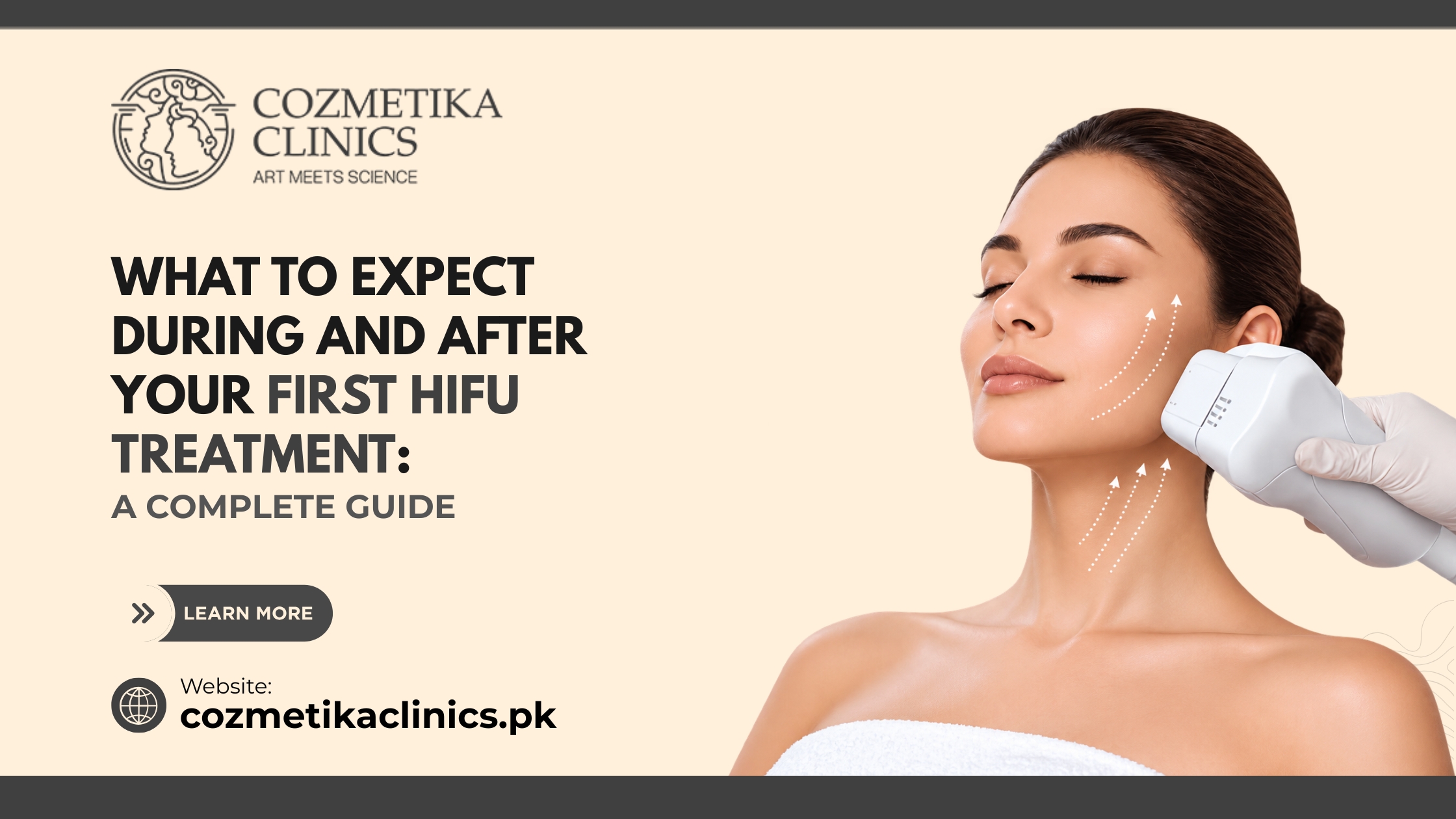
HIFU treatment may be a desirable option for people seeking firmer, more defined skin without undergoing surgery. High-Intensity Focused Ultrasound (HIFU) is a non-surgical skin-lifting procedure designed to stimulate collagen synthesis in the deeper layers of skin. It is widely used to tighten sagging skin, smoothen facial lines and to give a more lifted appearance.
If you are considering a HIFU treatment, you may find it easier to get through the process if you know what to expect, what you will feel during the treatment, the recovery process and the expected result. At Cozmetika Clinics Islamabad & Rawalpindi, we focus on personalized treatment plans, realistic expectations, and medically proven cosmetic treatment.
Understanding HIFU: How the Treatment Works
HIFU technology uses focused ultrasound energy for controlled delivery of thermal energy in the deeper layers of skin. This focused and controlled energy creates small areas of thermal stimulation to promote collagen remodeling. Collagen can help to improve firmness, contour, and skin health. It is therefore considered a non-surgical face lift HIFU treatment. However, HIFU cannot replicate the outcomes of a surgical facelift. It is best suited for individuals with early to moderate laxity who are looking for gradual and natural-looking results.
HIFU Treatment Procedure: What to Expect
The consultation begins with an evaluation of facial structure, skin quality and the extent of skin laxity. The consultant decides which areas need treatment and what treatment setting will be more appropriate.
The skin is cleansed and the ultrasound device is positioned over the treatment area to deliver ultrasound energy during HIFU skin-lifting procedure. This procedure can be carried out on the neck, jawline, chin, cheeks, and other areas where skin is sagging. Treatment approach and outcomes vary as per the degree of skin laxity.
A frequently asked question by first-time patients is the level of pain associated with the procedure. HIFU treatment pain level will depend on the treatment area, energy setting and individual tolerance level. Some people report mild tingling, warmth, pressure or mild discomfort during ultrasound application. The procedure can be done on most patients without any discomfort or trouble.
Duration of HIFU Session
One of the frequently asked questions is, “How long does HIFU take to work?” There are in fact, two time frames: duration of session and result timeline. The actual treatment time is about 30-90 minutes, depending on the treatment plan and area to be treated. However, the results develop slowly since collagen remodeling will take time.
HIFU Recovery Timeline
One of the benefits of HIFU is that there is usually not much to disrupt day-to-day activities. HIFU generally does not require a lengthy recovery time, unlike surgery. Some patients might experience temporary inflammation, redness, sensitivity or tenderness for a very short period of time.
The HIFU recovery timeline varies from person to person, but many people return to their normal activities soon after treatment. Hence, it is a good choice for people anticipating minimal HIFU downtime.
HIFU Results Timeline
Instant results cannot be expected however, there is some improvement in firmness immediately following treatment, and more significant results occur gradually over time. As collagen remodeling progresses, the results of HIFU are more noticeable. Visible improvement can take several weeks and months to develop, depending on individual factors and treatment plan. The result may be influenced by the patient’s age, skin laxity, skin condition, lifestyle and patient’s response to collagen.
HIFU Treatment Risks
When performed properly, HIFU is normally well tolerated. However, temporary side effects can occur that usually settle on their own. HIFU treatment side effects include temporary swelling, mild redness, tingling, sensitivity, tenderness and mild bruising in some cases.
HIFU Aftercare Guide
HIFU post-treatment care assists in keeping the skin relaxed while it goes through its natural process of collagen remodeling.
Patients are advised to follow the instructions provided by clinician such as maintaining gentle skincare routine, protecting the skin from sun exposure, maintaining hydration, and avoiding unnecessary irritation.
The clinician may also advise avoiding selected facial treatments depending on the procedures a patient normally undergoes or skin condition.
First HIFU Treatment: Essential Tips
· Choose evaluation over assumptions: HIFU is not suitable for all skin types or every degree of skin laxity.
· Understand your objective: The practitioner must understand the goals a patient is seeking such as a sharper jawline, subtle lifting, or improved facial firmness.
· Expect steady enhancement: HIFU works by collagen-stimulating mechanism, and it is not an instant therapy.
· Treatment plan. Treatment areas, depth and energy settings must be chosen as per individual needs.
· Focus on certified care: Treatment method, device quality, and clinical assessment influence results and safety.
HIFU Treatment Cost
HIFU treatment cost depends on the number of shots, the treatment area, technology used, and customized treatment plan. The treatment of smaller areas may differ considerably from face-neck treatment.
At Cozmetika Clinics Islamabad & Rawalpindi, every treatment begins with understanding, not just performing a procedure. Our team discusses expectations, evaluates the skin, and develops a treatment plan suited to the patient’s concerns.
FAQs
1. Is HIFU a painful treatment?
HIFU causes slight warmth, discomfort, or tingling but it is generally a well-tolerated procedure.
2. How long is the recovery timeline of HIFU?
HIFU takes minimal recovery time, and most patients resume their normal activities soon after the procedure.
3. How long does HIFU last?
HIFU lasts for several months or even longer, subject to the patient’s skin condition, age, lifestyle and collagen response.
4. Who is a good candidate for HIFU?
HIFU is generally not suitable for everyone, therefore, a consultation is necessary to understand whether it aligns with goals and skin concerns.